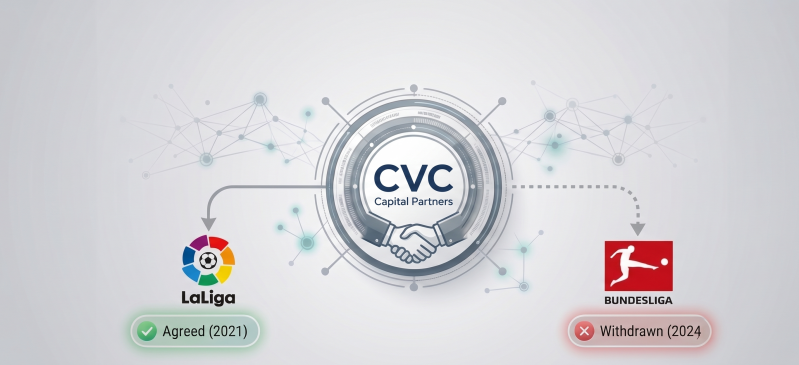
When the ENIC Group acquired stakes in Tottenham Hotspur and Glasgow Rangers in 1997, it marked the quiet arrival of private equity in European football. Over the following decades, institutional capital transformed individual clubs—from AC Milan to Manchester City—into global financial assets. Today, however, the sport faces a far more radical paradigm shift: private equity is no longer just buying clubs; it is buying into leagues themselves.
Pioneered by CVC Capital Partners in LaLiga and Ligue 1, this league-wide investment model promises instant billion-euro cash injections for infrastructure and global digital reach. Yet, as the collapse of the DFL's investor deal in Germany proved, trading future media revenues for immediate liquidity is a trade-off that collides directly with fan culture and traditional governance.
Why are European football leagues turning to private capital, how are these funds actually deployed, and why did Spain and Germany reach completely opposite verdicts?
The Catalyst: Structural Disadvantage Meets Pandemic Crisis
The Bundesliga and LaLiga firmly position themselves as the second and third highest-revenue football leagues globally. Yet, the financial gap separating them from the Premier League remains vast. Driven by unmatched international broadcasting rights, England's top division generates annual revenues that nearly match the combined output of LaLiga and the Bundesliga (see Chart 2).
As domestic broadcasting revenues reach saturation, leagues must look beyond traditional rights to drive growth. Modernizing stadiums into year-round commercial venues, scaling international brand presence, and building proprietary digital infrastructure represent some of the most viable paths forward. However, capturing these opportunities demands substantial capital that standard broadcast deals cannot immediately supply.
Compounding this long-term disadvantage, the COVID-19 pandemic delivered a severe shock to European football, causing matchday and commercial revenues to fall dramatically across consecutive seasons (see Chart 3). However, the timing and underlying motivation for seeking private capital differed fundamentally between the two leagues:


- LaLiga (2021): Entered negotiations at the height of the pandemic, driven by an acute balance-sheet problem that saw the league's aggregate Equity Ratio (Equity / Total Assets) drop from a pre-pandemic 25.5% to 17.7% in 2020/21. For Spanish clubs, CVC’s injection served as both a long-term strategic growth fund and an immediate liquidity lifeline to offset severe losses.
- The Bundesliga (2023–2024): Initiated negotiations long after the acute financial shock of the pandemic had subsided. Their push was driven almost entirely by long-term strategic growth—aiming to fund central media infrastructure and international marketing rather than rescue struggling club operating budgets.
The Architect: CVC’s Sports Portfolio
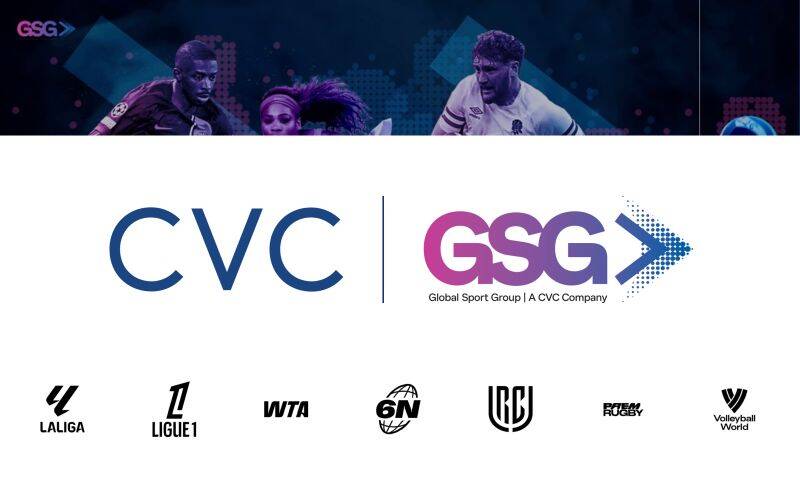
To evaluate private equity's expanding role across European football leagues, it is essential to understand the primary institutional investor driving this playbook. Luxembourg-based CVC Capital Partners is a private equity firm with extensive sports commercialization experience across Formula 1, MotoGP, Ligue 1, and Six Nations Rugby.
CVC’s strategy centers on investing in central governing leagues rather than individual clubs. Targeting the league level significantly reduces financial risk by protecting the fund from team performance volatility, relegation, and local board mismanagement.
Structurally, CVC acquires a minority stake—typically between 8% and 15%—in a newly created commercial subsidiary that controls the league's centralized broadcasting and media rights over an extended horizon (ranging from 20 to 50 years). Rather than managing daily pitch operations or transfer budgets, CVC acts purely as a commercial catalyst—using upfront capital to professionalize digital infrastructure, accelerate global TV rights distribution, and extract steady yields from undervalued media assets.
LaLiga Impulso: Private Equity in Practice
When CVC acquired an 8.2% stake in LaLiga’s audiovisual rights across the top two divisions for 50 years, it provided a net capital injection of €1.994 billion. To prevent clubs from burning this liquidity on short-term liabilities like transfer fees or immediate debt liquidation, LaLiga enforced a mandatory 70/15/15 capital allocation framework:
- 70% - Long-term investments: Mandatory allocation for long-term growth initiatives, including stadium overhauls, digital capabilities, international expansion, and CRM technological infrastructure.
- 15% - Debt Refinancing: Maximum allowance to clear existing high-interest balance-sheet liabilities.
- 15% - Squad Costs: Maximum allowance for squad registration and wage-bill flexibility.
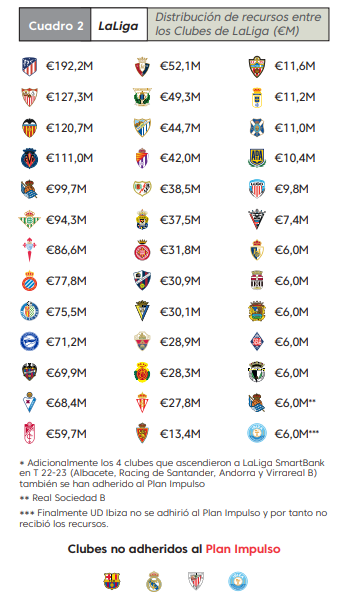
Clubs execute these strategic plans in close consultation with advisors from LaLiga's internal club office. Payouts were distributed in direct proportion to each team's average share of total broadcasting revenues over the preceding seven years (see Cuadro 2).
This capital has indisputably accelerated structural modernization across Spanish football. Physically, several clubs launched major stadium overhauls (Villarreal CF, Real Betis, Levante UD) and state-of-the-art training complexes (Atlético Madrid, SD Eibar, Girona FC). Digitally, clubs deployed capital into business intelligence platforms to monetize global fanbases (Sevilla FC), smart stadium 5G connectivity (CA Osasuna), and in-house media production studios (Cádiz CF).
However, the agreement did not receive unanimous backing. Four clubs—Real Madrid, FC Barcelona, Athletic Club, and UD Ibiza—opposed LaLiga Impulso. They contended that a 50-year commitment was excessive and that surrendering 8.2% of future audiovisual revenues for half a century was far too costly long-term. Consequently, these dissenting clubs utilized an individual opt-out mechanism, giving up their upfront financial payouts to retain their future broadcasting revenues.
The DFL Proposal: Germany’s Rejected Deal
In May 2023, Germany’s DFL first attempted to secure private equity investment by proposing to sell a 12.5% stake in its media rights subsidiary for €2 billion, but the proposal was rejected by the clubs. Scaling back its approach, the DFL introduced a revised plan in December 2023 to sell an 8% stake over 20 years for €1 billion, attracting interest from four private equity firms, including CVC and Blackstone.
This second vote narrowly passed, securing the exact two-thirds majority required (24 out of 36 clubs across the top two divisions). The revised €1 billion fund was structured into three distinct buckets:
- €600 Million - Central DFL Investments: Retained centrally by the DFL to fund digitalization, central tech/OTT platforms, and global marketing ventures.
- €300 Million - Media Rights Compensation: Distributed directly to individual clubs based on media interest to offset initial revenue losses from surrendering future broadcast rights.
- €100 Million - International Travel Incentive: Set aside as a financial incentive to encourage clubs to embark on overseas promotional tours.
Fan Objections and Match Disruptions
Despite the vote passing, the decision sparked immediate outrage and widespread protests across German stadiums. Opposition centered on four core arguments:
- Lack of Democratic Consultation: Fans strongly criticized some club executives for voting on long-term commercial commitments without consulting their voting members.
- Fear of Investor Influence: Supporters distrusted governance assurances, fearing an investor would gain subtle influence over match scheduling or kickoff times.
- Widening Financial Disparities: Critics argued that distributing €300 million based on media interest ensured the "rich get richer and the poor get poorer."
- Perceived 50+1 Violations: When Hannover 96’s executive allegedly voted "Yes" against the explicit instruction of his member-led parent board—providing the exact 24th vote needed to pass—fans viewed it as an illegitimate breach of democratic club control.
Growing Doubts and Final Collapse
These arguments fueled relentless protests that disrupted top-flight matches for weeks, with supporters throwing tennis balls, chocolate coins, and remote-controlled cars onto pitches. As matchday operations repeatedly broke down, a growing number of clubs called for a re-vote, while prospective investors lost confidence because of the unstable environment. With internal consensus shattered, the DFL officially cancelled all negotiations in February 2024.
The Private Equity Divide: LaLiga vs. Bundesliga
| Dimension | LaLiga (LaLiga Impulso) | Bundesliga (DFL Proposal) |
|---|---|---|
| Market Context | Height of COVID-19 crisis; urgent liquidity needs | Post-pandemic recovery; healthy balance sheets |
| Ownership Model | Predominantly SADs (Corporate, top-down executive authority) | 50+1 Rule (Commercial entities controlled by member-led parent clubs) |
| Deal Volume & Stake | €1.994B for an 8.2% stake | ~€1.0B for an 8.0% stake (prev. €2B for 12.5%) |
| Duration | 50 Years | 20 Years |
| Total Media Revenue | ~€1.70 Billion / year | ~€1.70 Billion / year |
| Nominal Revenue Cost | €6.97 Billion (surrendering ~€139.4M/yr over 50 years) | €2.72 Billion (surrendering ~€136.0M/yr over 20 years) |
| Capital Allocation | Decentralized (100% to clubs via 70/15/15 growth framework) | Central-Heavy (€600M DFL tech/OTT, €300M media loss buffer, €100M travel incentives) |
| Governance & Power | Centralized league leadership; dissenting clubs could individually opt out | Required 2/3 majority of 36 clubs; no option for individual club opt-outs |
| Resistance | Legal action by 4 dissenting clubs (3 being non-SAD, member-owned) | Widespread fan protests in stadiums forcing complete cancellation |
| Status | ✓ Successfully implemented (2021) | ✕ Failed / Cancelled (Feb. 2024) |
Note: All long-term financial costs and revenue projections are calculated using nominal values, unadjusted for inflation or future market growth.
Beyond the raw metrics, four underlying dynamics explain why the two leagues reached opposing verdicts:
- The "Growth Bet" vs. Fan Skepticism: The central financial thesis for both leagues was that retaining ~92% of a rapidly expanding, private equity-accelerated revenue pie is more lucrative than keeping 100% of a stagnant one. While Spanish clubs trusted the deal to multiply international and commercial revenues, the German grassroots viewed the promised growth as highly speculative, concluding that the organic growth of the Bundesliga was sufficient without diluting member control. Crucially, the practical allocation of funds exposed a deep divergence in narrative: LaLiga delivered a clear, tangible value proposition to supporters by making clear that clubs invest a part of the capital directly into visible infrastructure, such as stadium modernizations and training ground rebuilds. In contrast, the DFL centered its proposal on abstract, central-level buzzwords like "digitalization" and "internationalization." With capital retained at the league executive level rather than flowing directly into local club development, German fans had little reason to accept the sacrifice of long-term broadcast rights.
- Need vs. Want: Spain used private equity as an essential rescue package to restructure debt and build modern infrastructure post-COVID. Germany approached private equity as an optional growth accelerator; without an existential financial threat, clubs and fans had no incentive to compromise on governance or long-term revenue.
- The True Cost Calculation: LaLiga clubs essentially traded €164 million in annual operating income across 50 years for a single €1.994 billion injection, surrendering over €8.2 billion in gross broadcast income long-term. In contrast, DFL clubs were asked to sacrifice roughly €100 million per year out of their €1.25 billion pool (~€2.0B over 20 years). German clubs still concluded that forfeiting €100M annually from an already tighter broadcasting market was an unnecessary price to pay.
- Democratic Membership vs. Corporate Structure (50+1 vs. SAD): Underpinning the entire conflict is a fundamental clash in ownership structures and fan identity. Through Germany’s 50+1 rule, fans view themselves as active co-owners and democratic guardians with a fundamental right to decide their club's future. When the DFL pushed through a second vote within a single year—relying on secret voting without transparent communication or open dialogue with fan bases—German supporters viewed it as an undemocratic, top-down circumvention of their authority. In contrast, the vast majority of LaLiga clubs operate as SADs (Sociedades Anónimas Deportivas), private corporate entities where executive boards make top-level financial choices independently. Because Spanish fans lack the constitutional member-ownership structure provided by 50+1, decisions were handled strictly as corporate governance matters and accepted by supporters without the institutional mechanisms or cultural mandate to revolt.
Conclusion: The Price of Equity vs. The Value of Sovereignty
The contrasting outcomes of private equity proposals in Spain and Germany illustrate a fundamental divide in modern sports finance. Beyond the underlying valuations, the debate ultimately hinged on governance models and strategic priorities. Neither outcome represents an absolute ideal; rather, each decision reflected the specific financial realities and institutional frameworks of the respective league.
Strategic Pragmatism - LaLiga’s Modernization Drive: For LaLiga, accepting the CVC agreement was a pragmatic response to severe post-pandemic balance-sheet constraints. Facing elevated debt levels and a pressing need to modernize stadium and digital infrastructure, Spanish clubs required upfront liquidity to remain globally competitive. Given LaLiga’s corporate framework—dominated by Sociedades Anónimas Deportivas (SADs)—and its strategy centered on global brand expansion, monetizing a minority share of future broadcast rights provided a structured pathway toward debt relief and capital expenditure.
Institutional Alignment - The Bundesliga’s Model Protection: For the Bundesliga, walking away preserved its distinct operational and commercial alignment. The league faced far less immediate solvency pressure and already possessed mature venue infrastructure. Crucially, the DFL protected the core identity encapsulated by its own official league tagline—"Football as it's meant to be"—an institutional framework anchored in the 50+1 rule, fan accessibility, and member-led governance. In an increasingly consolidated European football market, the Bundesliga chose to maintain its structural independence. By rejecting CVC’s capital injection, German football prioritized governance integrity and member control over accelerated, equity-funded growth—demonstrating that capital structure must ultimately align with a league’s foundational governance model.
Future Prognosis: Diverging Trajectories
Looking ahead, both leagues now face vastly different strategic challenges resulting from these pivotal decisions:
- LaLiga’s 50-Year Gamble: The true test for Spanish clubs will emerge in the coming decades. Clubs will still be forfeiting 8.2% of their media revenue until 2071. For this deal to be judged a long-term success, LaLiga’s centralized investments must generate exponential growth to outpace the annual revenue loss.
- The Bundesliga’s Authentic Alternative: Having firmly closed the door on private equity, the DFL must now find alternative, non-dilutive ways to fund its necessary digital and international expansion, likely through traditional commercial partnerships and bank financing. However, its path forward is clear: leaning fully into its unique selling proposition. The league must globally monetize its authenticity—full stadiums, vibrant fan culture, and member-owned traditions—proving that it can remain highly competitive without sacrificing democratic control.
- The Premier League Shadow: Regardless of their diverging strategies, both LaLiga and the Bundesliga remain united by a common threat: the financial supremacy of the English Premier League. Private equity will continue to circle European football, but as this comparative case study proves, the deployment of that capital will always be dictated by the cultural and structural DNA of the league it attempts to enter.
Key Learnings: LaLiga vs. Bundesliga
Article by Alex for Sport Across Borders — exploring how sport connects culture, management, and innovation worldwide.
Sport Across Borders connects sport, culture, and innovation worldwide.
Coming soon: A monthly dose of global sport insights — short, thoughtful, and beyond borders.
Add comment
Comments